How to Clean Your Scuba Gear After a Trip

You just got back from a dive trip, your gear smells like the ocean (not in a good way), and it’s tempting to just toss it in a corner until next time.
Because the dive shop washed it, right?
Maybe, but if you’re going to store it for a few months before your next dive trip, take some time to give it some love and a deep clean.
Dive gear is expensive, and a few extra minutes of cleaning now is the difference between gear that lasts for years and gear that mildews, corrodes, or fails you on your next trip.
Here’s exactly how I clean my gear after every trip, piece by piece. No special skills or equipment required.
After your dive trip, rinse and soak all your gear in fresh, lukewarm water as soon as possible after your last dive. Regulators just need a gentle soak (no button-pushing), BCDs need an internal bladder rinse through the inflator, and everything needs to be completely dry before it goes into storage.
Regulator: The Most Delicate (and important!) Piece
Your regulator is your lifeline underwater, so treat it accordingly. These are your most delicate and usually most expensive pieces of dive gear. Here’s how we take care of it:
Dust Cap – take it off and check out the filter. Look for debris or rust. But DO NOT RINSE your first stage.
Second Stages – place the second stages in warm water and let them soak. Do not push the purge buttons or shake them, be gentle! The warm water will work out any salt that got in to the mouthpiece or diaphragm.
That’s it! Let it soak for an hour or overnight, then hang somewhere to dry.
BCD: The Most Overlooked
Most divers dunk their BCD in the rinse tank after a dive and don’t think twice about. But BCD’s deserve love too!
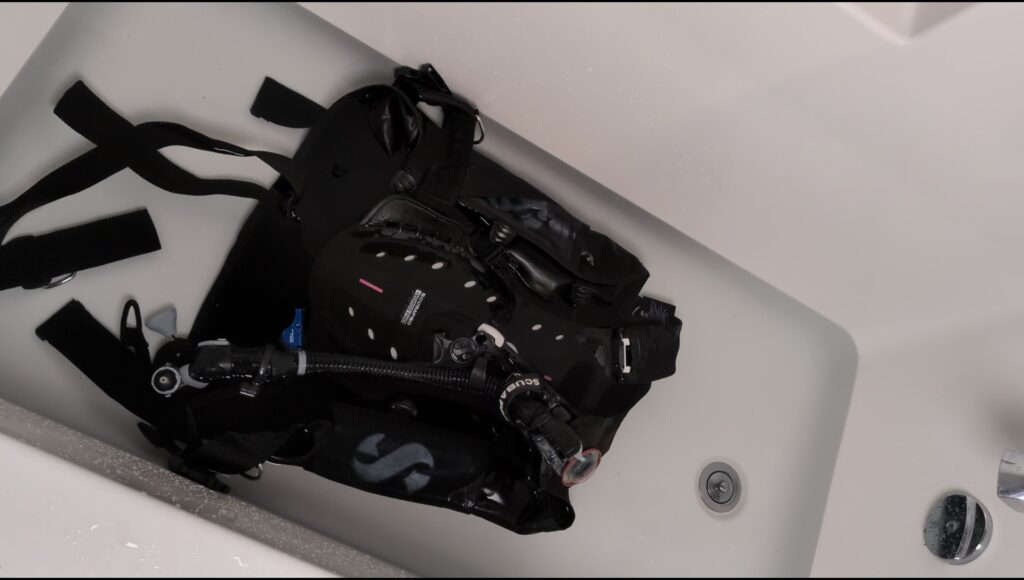
The easiest way to clean your BCD and the rest of your gear is in a tub, but if you don’t have one you can use a shower or even your garden hose.
Soak – fill your tub with warm (not hot) water. Do NOT add anything to the water.
Push your buttons – push all your buttons when submerged in the water and pull your dump valves under the water so it gets through.
Rinse the bladder – I like to unscrew the dump valves and swish water inside. Flush water through the inflator hose by pushing the deflate button while under the water.
If you’re not comfortable doing that, you can direct water into the inflator hose with a tap or garden hose, and press the deflate button. This will allow water to fill the bladder.
Then you can swish it around, and drain it.
Inspect your valves – I like to unscrew my dump valves and take a look at the o-rings. Just check for debris and if the o-rings are dry or cracked.
Leave your BCD soaking for at least 30 min, but I like to do a couple hours.
Drain – replace your dump valves, and remove the water from the bladder by holding the BCD upside down and pressing the deflate button. Make sure you get all the water out!
Also push the inflate button for a few seconds to run water through your LPI connection. That gets rid of salt or dust that might have worked its way in there.
Inflate – orally inflate your BCD all the way, until you hear the burst valve give.
Inspect – now that your BCD is fully inflated, check the exterior for scuffs, tears, or leaks.
Leaving your BCD inflated for a few hours or overnight is a way to check for leaks. If you come back and it has lost some shape, you might have a tear or faulty o-ring.
Dry – while fully inflated, hang to dry on a BCD hanger, or a chair (I put a towel underneath so it can drip).
Let dry for a couple of days until all webbing and parts have dried completely.
Everything Else: Mesh Bag, Boots, Fins, DSMB, Mask & Wetsuit
Once the delicate stuff is done, I rinse the rest of my gear all together in the tub! Now this is the smelly stuff usually, so you might want to add something to the water.
This type of gear is less sensitive so you don’t have to be so careful with what you put in the water.Ssince my gear deserves nothing but the best, I add a few drops of Gear Wash from Stream2Sea.
I know some that use fabric softener or a bit of laundry soap, but remember that anything you use will eventually wash out in the sea. So try to keep it biodegradable. I’m also allergic to heavily scented products, so I stay away from that stuff.
DSMB
If you have a buoy with a dumb valve, I unscrew that and flush fresh water through it in the tub.
To drain, blow it up with air, hold the buoy with the dump valve facing downwards, and drain the water out of the dump valve.
Fulling inflate and let it hang to dry.
Dive Boots
Don’t half-ass cleaning your booties! These bad boys can stank after a trip and take their dear sweet time drying.
I soak my dive boots with gear wash for at least a few hours, then prop them up to dry. If you can put them outside that’s best, but I avoid direct sunlight.
Prop them up with the heels down so they can drain.
If they are stubbornly damp, stuff some silica packs in the toes to help speed up the process. I also use these reusable dehumidifier packs when storing my gear.
Wetsuit
I let my wetsuit and layers or any other neoprene have a nice long soak in the tub with the gear wash.
Never hang your wetsuit to dry by the shoulders. Its too heavy and you will stretch and warp the fabric
I hang mine doubled over a shower rod or something else with soft edges. Flip after a few hours and keep adjusting the position so it dries fully.
There’s a surfer device called Surf-Dry that is a portable wetsuit dryer. I think it would be great for liveaboards, but I haven’t tried it yet!

Cameras, Torches & Tech
Any tech that goes in the ocean needs to have the salt soaked out of it.
After your dives, it’s a good habit to soak your cameras, torches, and dive computer for at least an hour in freshwater. For this, I leave my computer in a mug or water glass. My cameras (in the housing), torches, and anything else goes in the hotel sink. Do it before you get in the shower!
After your trip, give everything a proper soak. Some technicians recommend soaking your torches overnight even just to make sure all the salt gets out.
Once they’ve soaked, lay out a towel and let everything air dry. When most of the water is gone, I open everything up, and lubricate the o-rings of my camera housing and torches with a touch of silicon grease.
Storing Dive Gear in Between Trips
Sadly, this is where your gear most likely spends the majority of its time!
I prefer to story my scuba gear in bins. Some divers are lucky enough to have a room or closet they can devote to their gear, but alas not I.
Make sure everything is dry
Before storing, everything must be completely dry. Do not put damp scuba gear in storage!
Damp gear molds, and we don’t want that.
Cover anything susceptible to dust
I put covers on my mouthpieces of my regulator to prevent dust and any creepy crawlies from being tempted to make a home inside.
Fold or Roll
Fold wetsuits along the natural bends in the elbows and knees. we want to limit creasing as much as possible. Try to avoid stuffing or putting heavy items on top. The neoprene easily rips when dry.
Control Humidity
I put some of these reusable silica packs in with my gear. You can stuff them in your booties, wetsuit, and tuck them into corners of the bin.
These will help trap any dampness that manages to make it in.