
How to Pack for a Dive Trip

It’s time, let’s talk packing.
Packing for any trip can be tricky, but dive travel is its own beast. Dive gear is heavy, airlines have strict rules around batteries and luggage weight, and you also have to think about sun protection, wet clothes, long travel days, and staying warm underwater.
I have been travelling almost exclusively for scuba diving since 2021, and I have tried just about every packing setup possible. I started with two backpacks, upgraded to a carry-on rolly bag after one very memorable walk through LAX, and now usually travel with two backpacks and a suitcase.
Because I travel full-time, I am not just packing for one vacation. I am packing for airports, dive boats, tropical weather, long-haul flights, and everything I need to keep moving comfortably.
Over the years, I have learned what I actually need, what makes dive travel easier, and what only comes along if there is extra space.
In this guide, I’ll break down what I pack in my personal item, carry-on, and suitcase, plus my dive travel packing system, space-saving strategies, and complete scuba trip packing list.
So, let’s get packing for our dive trip.
My Packing Philosophy
I live by three main rules when it comes to packing. Honestly, I apply this methodology when shopping too.
Everything I pack should:
- Make me feel good
- Make me look good
- Have more than one purpose
I try to hit at least two out of the three points with every item I bring. It helps me decide very quickly if something deserves space in my bags or not.
Weight is also a huge consideration for me. Dive gear gets heavy very fast, so I try to choose loose, lightweight clothing whenever possible.
Coming Home
We don’t want to think about it when getting ready for a trip, but post-trip Shev is always grateful I made a system that considers repacking when your gear & clothes are dirty & damp.
Whatever your philosophy, packing for the return trip needs to be a part of it.
👜Personal Item: Essentials That Stay With Me
My personal item is where I keep my most valuable items, plus anything restricted by airlines.
This is the one bag that never leaves my side.
Essentials & Travel Documents
I actually have a sneaky cross-body bag that I put my passport & phone in and hide on my waist or under a sweater. If I’m not using it, I put my passport in the hidden pocket on my CORSurf Island Hopper backpack.
Important Documents are:
- passport
- visas
- residency cards
- immigration paperwork
- wallet
- boarding passes
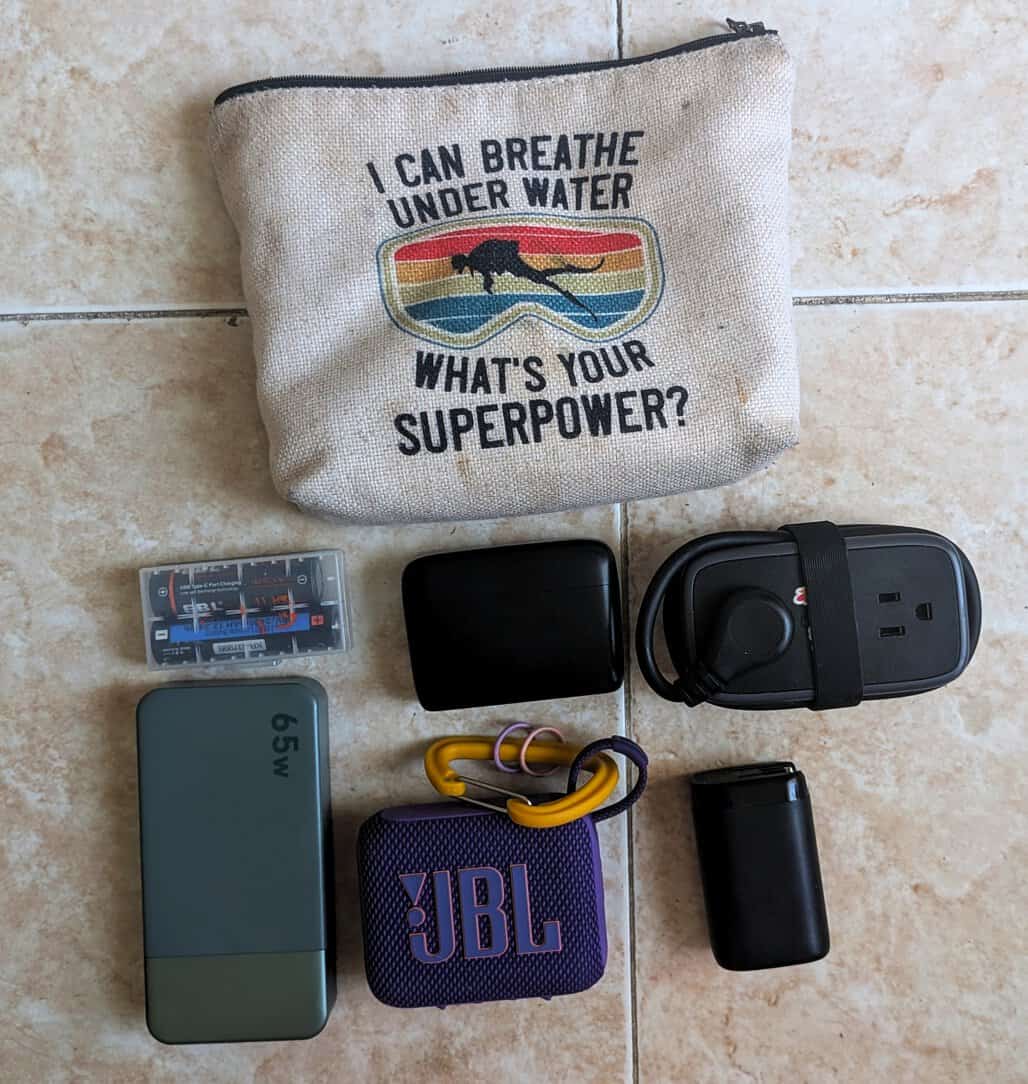
Tech & Electronics
Electronics restrictions on airlines are becoming tighter every year, especially around lithium batteries and power banks.
In many parts of Asia, power banks are not even allowed in your overhead carry-on. They need to stay under the seat with you in your personal item.
All of my technology is rechargeable. I go out of my way to find batteries I can recharge via USB, so these items go in my backpack under the seat in front of me.
- power bank
- battery bag for rechargeable dive lights and cameras
- laptop
- drone
- phone charger
- universal travel adapter
- power bar
A power bar is one of my favourite travel hacks. It makes me very popular at airports! There are never enough outlets.
Most of these items are what I consider my “true essentials”. If nothing else arrived at my destination, I could get by with my wallet, phone, passport, laptop, & chargers. Everything else is figure-outable.
Shev’s Plane kit
I have a small pouch that I call my “plane kit.” I originally made it for my first long-haul flight, and now I never travel without it.
Inside I keep:
- hand sanitizer
- chapstick
- face wipes
- toothpaste
- protein bar
- tea bags
- electrolyte packages
- a sweet treat
Having everything in one small bag makes long travel days so much easier. When I get to my seat, I take it out and put in the seat pocket for easy access.
What I wear on the plane
Somehow, planes & airports are never comfortable. I am either sweating or freezing! That’s why I love the crop-top & sweater combo.
I usually wear:
- my comfy plane pants
- a cropped tank
- my hoodie
Long-haul flights are not the time for restrictive outfits, but I don’t like looking like a slob either. Casual comfort is my sweet spot.
Personal Item or Carry-On
There are a few more things to have with you on the plane, but which bag they are in is not important.
- cameras
- external computer monitor
- emergency change of clothes
- swimsuit
- filtered water bottle
🧜♀️Tip from Shev: If you gate check your carry-on, make sure you take out the cameras and your emergency clothes and put them in your personal item!
Make-Up Bag
Not my full toiletries, but with me I have:
- facewash
- toothbrush & toothpaste
- moisturizer
- basic make-up
This is because I like to do a refresh in the airport between flights. Wash my face, change my clothes, brush my teeth, etc.
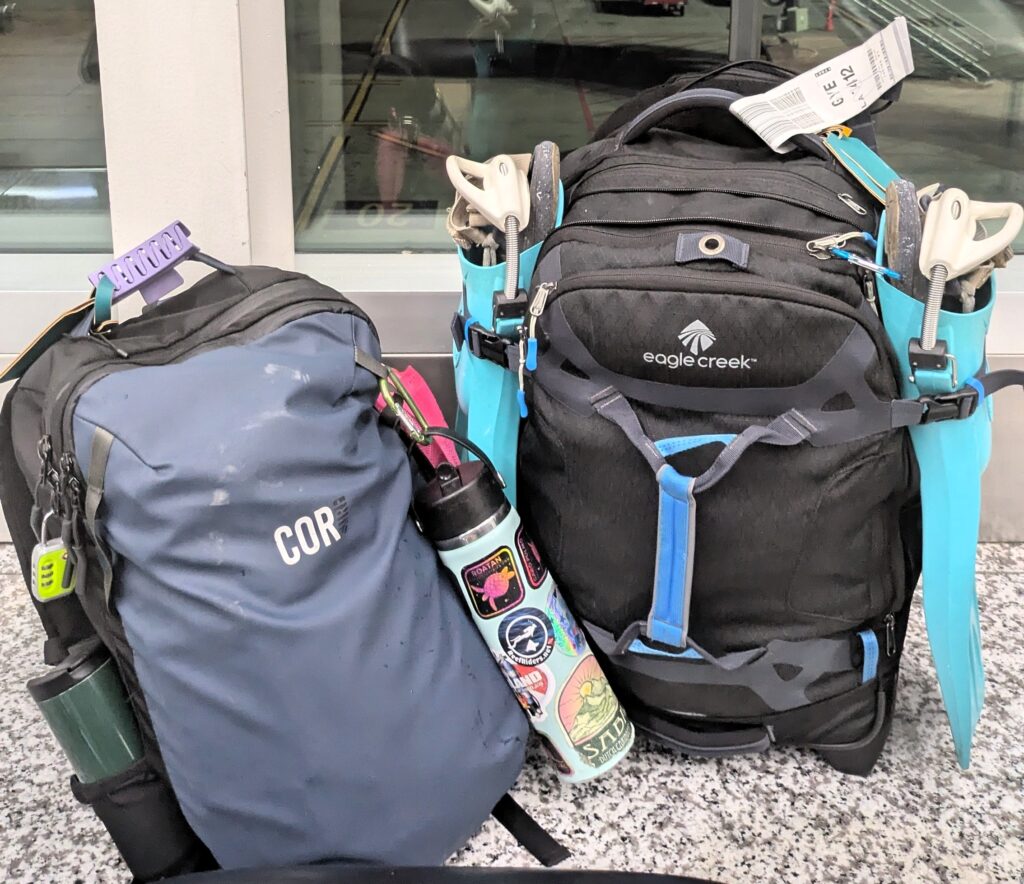
🎒Carry-On: Fragile Dive Gear & Basics
My carry-on is mostly for expensive or fragile dive gear that I do not trust airlines with. For scuba diving, your carry-on should include the dive gear that would be hardest to replace if your checked suitcase were delayed.
It should also include the basic things you need to survive a day of diving, should your bag be delayed.
For me, that means my:
- regulator
- mask
- fins strapped to the outside
- make-up bag
- small toiletries
- medications
If you are comfortable renting BCDs and fins, those can usually go in checked luggage or be rented at the destination.
My full toiletry kit normally goes in my checked suitcase to save space.
I also like keeping one or two backup outfits in my carry-on just in case my checked bag gets delayed.
📢Did you know: some technicians say that the pressure & temperature changes in the baggage hold can deteriorate your o-rings quickly, especially in your regulator. That’s why I always carry mine on.
🧳Checked Bag: Clothes, Toiletries, & Bulky Stuff
My suitcase is for bulkier items, dive clothes, and less fragile items.
- BCD
- dive clothes
- land clothes
- yoga mat
- protein powder
- reef-safe toiletries
- hair products
- slides & hiking sandals
- wetsuit and layers
- laundry bag
- mesh bag
I try to organize everything into categories so unpacking at destinations is easier.
My full toiletry kit goes in my suitcase, and for dive travel, I pay extra attention to reef-safe sunscreen, hair care, and skin barrier support. Sun, saltwater, wind, and multiple showers a day can be surprisingly hard on your skin and hair, so this is one area where I pack pretty intentionally.
A smaller make-up bag of essentials stays with me in my personal item.
🧜♀️Tip from Shev: Everything that goes in my suitcase goes in a bag. Either a compression bag or a silicone ziploc. This keeps me organized and makes unpacking a breeze.
Complete Packing List
Everything I’ve mentioned, but in list form! I also made a pdf you can use for your packing days! It’s even got checkboxes and blanks for you to fill in yourself.
Travel Day Outfit
Plane Pants
Hoodie
Socks (regular or compression if flight is more than 6 hours)
Running shoes
Neck gator or headband
Dive Gear
Mask
Regulator
BCD
DSMB & reel
Boots
Fins
Dive Accessories
Camera
Camera leash
UW housing for camera
Selfie Stick
Torch
Extra batteries (camera)
Extra batteries (torch)
Save a dive kit
Home Office/Content Creating
See my full home-office set-up here
Camera (I use a DJI Action camera)
Tripod
Microphones
External Monitor
Power station with surge protection
65W Power Bank
Dive Clothes
Waterlust is my favourite place for dive clothes
1-2 shorts
1-2 leggings
3-5 rashguards
2 pairs dive socks
Thermal layer (vest or .5mm jacket)
*Wetsuit (if needed)
Surf Poncho
Land Clothes
3-5 crop tank tops
1 sundresses or casual outfits
1 romper / lounge outfit
2-3 shorts
1 skirt or skort
1 pair of slides
1 pair of sandals
Health & Fitness
yoga mat
lacrosse ball
resistance band
electrolyte powder or drops
protein powder
shaker
water filter & bottle
Shev’s Snack Bag
protein bars
tea
matcha
sweet treats
First Aid Kit
antiseptic wipes
electrolytes
waterproof bandaids
gauze
gloves
tweezers
spf chapstick
Dive Kit/Save a Dive Kit
Reef-Safe Defog
Zipties
Silicone Lube
Backup Dive Computer
Mouthpiece
Hair ties
O-rings (I have this cute one)
Medications
In my travel pillbox, I carry just a few of each of these:
Ibuprofen
Allergy Medication
Stool Softener
Anti-Diarrheal
Vitamin D
Sea-Sickness/Anti-Nausea
Parasite Medication
Charcoal Tablets
Melatonin
Toiletries & Skin Care
Dive travel is hard on your skin and hair. Between the sun, saltwater, wind, sunscreen, and multiple showers a day, I need to stay on top of protecting my skin and hair.
I try to pack products that are reef-safe, easy to travel with, and gentle on my skin. I also look for solid products whenever possible because they are lighter, less messy, and easier to fly with.
My toiletry kit usually has:
- reef-safe sunscreen
- leave-in conditioner
- face moisturizer
- solid shampoo
- concentrate conditioner
- solid face wash
- basic skincare routine
- makeup remover
- deodorant
- curl cream
- barrier balm or heavy moisturizer
- hydrating face mask
- spray bottle
- wet brush and wide-tooth comb
- lip mask or repair balm
To minimize weight, I try to avoid glass packaging and use refillable containers so I can bring only as much product as I need. I also like brands like Stream2Sea, Everist, & Attitude because they offer more travel-friendly and lower-waste options.
Leave-in conditioner is one of my biggest non-negotiables on dive trips. Saltwater and sun can make my hair feel like straw very quickly, so having something I can use after diving makes a huge difference.
🧜♀️Tip from Shev: I mix my leave-in conditioner (I only use Stream2Sea) with my curl cream & water in a small spray bottle. Spritz it on my wet hair after I shower, and comb through with my wide-tooth comb.
For my skin, I focus more on hydration and barrier support than anything fancy. After a few days of diving, my skin usually needs moisture, lip care, and gentle products more than a complicated routine.
But, I am in my 30s, so I do have my The Ordinary basics that I use daily.
My Dive Trip Packing System
Ok, now that you know where everything goes, here is how you actually pack it. My system focuses on staying organized, protecting fragile gear, and making sure I can function if a bag is lost or delayed.
| Item | Technique | Where it Goes |
|---|---|---|
| Land Clothes | 1 medium compression bag | Checked Bag + 1 outfit in carry-on |
| Dive Clothes | 1 medium compression bag | Checked Bag + 1 outfit in carry-on |
| Toiletries | Extra-Large Silicone bag | Checked bag |
| Electronics | Zipper pouch | Carry-on |
| Batteries & Powerbanks | Zipper pouch | Personal Item |
| Dive Accessories | Zipper pouch | Carry-on |
| Wetsuit & Layers | Use to pad BCD | Checked bag |
| Snacks | Medium Silicone bag | Checked Bag |
Putting things in the same place every time is a game-changer for packing. No wondering how you will fit things when leaving your holiday. You know where they go.
How to Pack Your Dive Gear
Regulator
This is your most delicate and usually most expensive item. Some people like regulator bags (like this adorable whale shark one), but I can’t justify the extra space and weight.
I use these neoprene dust covers for my second stages, and then pack my regulator loosely in my carry-on, using my dive & clothing set to cushion it.
BCD
When travelling with only carry-on, my BCD goes in the overhead bin. When I have a checked bag, I put the BCD there.
Your BCD is probably the least delicate piece of dive gear. I put it on top of my yoga mat, and stuff my poncho and DSMB around it for protection.
Fins & Boots
I almost always carry my fins on as their own item. I have never been questioned for it, but I know others who have. I clip them to the outside of my carry-on bag, or just hold them in my hands.
On the plane, I put them on top of my carry-on in the overhead bin, or next to my personal item under the seat.
My fins weigh about 4 kilos/10 lbs on their own, so it’s not feasible to pack them in a checked bag. But, if I can upgrade my bag weight to 30 kilos, then I will check them.
Camera Gear
I don’t have fancy cameras, just an action camera and the Olympus TG6.
The cameras go in my personal item with me, and the housing goes in my checked bag.
Accessories
I have a small silicone sandwich bag for my dive kit. That goes in my checked bag.
My torch (without the batteries) goes with the dive kit or in my electronics bag. Wherever there is room.
🧜♀️Tip from Shev: I always pull my regulator out of my bag when going through security. It saves me so much time, because 8/10 times it will be pulled aside for additional screening if I don’t.
Things I Don’t Compromise when Packing
Dive clothes
I have always packed too many land clothes, but I have rarely regretted packing extra dive clothes.
I do a lot of women’s dive trips, and we love taking photos together. I also hate putting wet clothes back on, so I like having enough outfits for at least two full dive days.
Dive Gear
I am never sad that I packed a torch.
That said, I also try not to bring duplicates of things unless necessary. Dive gear gets heavy quickly, and there is a balance between being prepared and overpacking.
Mobile Office
Since I work remotely and spend a lot of time on my computer, I don’t compromise on my mobile office set up. My productivity depends on my comfort!
Travel Hacks for Packing Dive Gear
Neck Pillow
My mom actually made my neck pillow for me, and it is one of my favourite travel items.
It’s just the shell with a strap attached for safekeeping, plus a little pouch where I keep my eye mask and headphones. It can hold 1-2 changes of clothes, socks, & underwear.
Power bar
A power bar is one of the most underrated travel items.
Airports and hostels never seem to have enough outlets, especially when you are travelling with dive lights, cameras, drones, laptops, and power banks. I have met so many fun people just by sharing my power station!
My power bar also has surge protection to protect my laptop from unreliable grids around the world.
Bring a Wash Bag
I am partial to my Scrubba bag, but I have friends who prefer a collapsible bucket like this one.
Paired with some earth-friendly laundry detergent, I have the perfect combination to wash smaller clothing items, but more importantly, my dive clothes.
Swimsuits and rashies get smelly fast when worn in the ocean. I take my wet clothes into the shower with me, wash them in my bag, and hang to dry in the sun.
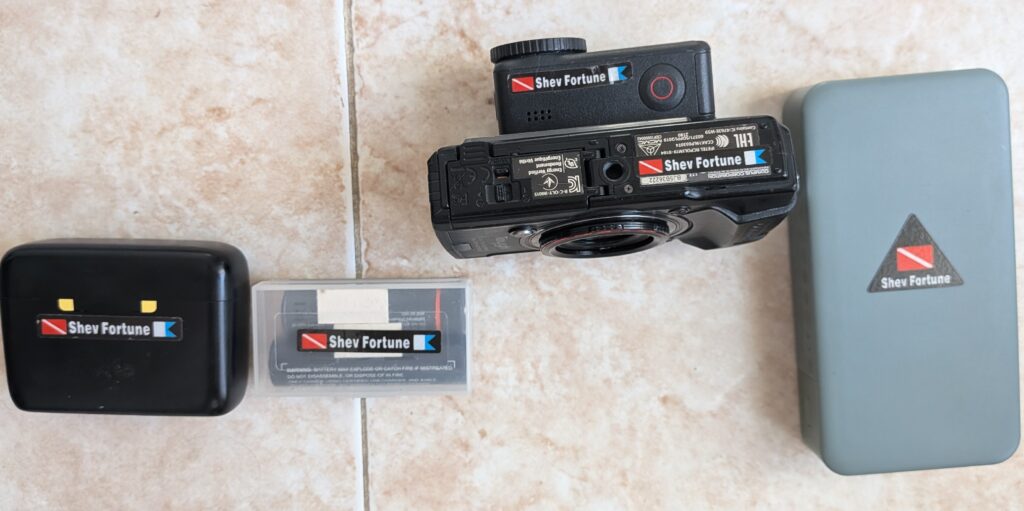
LABEL EVERYTHING
Get a sheet of these customizable marine labels, and put them on everything you own. I’m talking:
- all dive gear (I’ve had them on my reg and BCD for hundreds of dives, they stay!)
- charging cables
- batteries (especially GoPro and torch. Everyone has the same)
- fins
- anything you like and don’t want to disappear
Packing for the Journey Home
It’s one thing to pack a bag of perfectly clean and tidy clothes & gear, and another after a week of salt & sea. Here are some strategies I use to get everything back in the bags they arrived in:
Dirty Clothes
I use 2 packing cubes, one for dive clothes and one for land clothes. As I wear them, I switch to using one cube for dirty clothes and one cube for clean.
If that won’t work, I put my dirty clothes loose in the zipper side of my checked bag.
Damp Clothes
Things don’t always dry fully. That’s where my Scrubba bag comes in handy. Great for washing during the week, and at the end of the trip, it seals up damp gear nicely. No smelly suitcase, thanks!
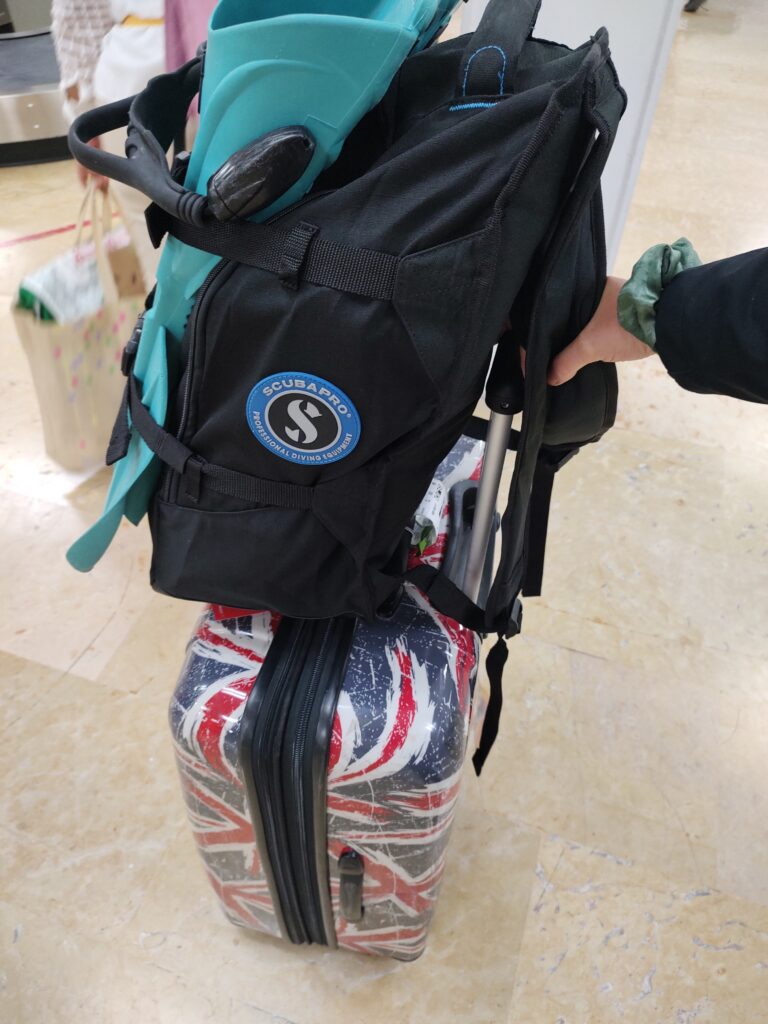
Biggest Packing Struggles
Weight
Weight is my biggest packing struggle by far.
I almost always have extra physical space in my bags. The problem is that dive gear becomes heavy incredibly quickly.
Choosing lightweight luggage is the biggest impact you can make. I had a suitcase in my cart and right when I was about to purchase, I read that it was 12 pounds. 12! That’s 1/5 of your alloted weight right there.
Hot Tip – Soft luggage can sometimes weigh less than hard-shell bags, but not always.
Avoiding glass bottles when travelling makes a big difference too. Refillable silicone containers work great for toiletries.
🧜♀️Tip from Shev: Use solid toiletries wherever possible. I have used solid shampoo & conditioner for years, but I recently discovered solid skin care items like:
🍊vitamin c face cream
🧽make-up remover
🧴face wash
👁️eye cream
👃deodorant
and it’s changed my life!
Overpacking
Overpacking is honestly more of a mental challenge than a physical one.
For me, it helps to get comfortable with the “worst case scenario.”
I ask myself:
- If my bag didn’t arrive, would it ruin my trip?
- Would I still have a good time?
- What do I actually need?
For me, the true essentials are:
- my mask
- my regulator
- one land outfit
- one swimsuit
- one rashguard
- my laptop
My own regulator and mask help reduce anxiety underwater. If I am using rental gear that does not breathe as comfortably, I notice it immediately, and it distracts me from my dives.
How to Avoid Overpacking
One of the best ways to avoid overpacking is to stop packing for imaginary scenarios.
Remember – you do not have to take care of everyone else. So many of my friends pack “just in case” items for people they “might” meet on a trip.
Most dive destinations are casual. You probably do not need five fancy outfits or multiple pairs of shoes.
I also try to remember that if I truly forget something important, I can usually buy it.
Packing lighter does not mean being unprepared. I pack everything important; I am just intentional about it.
Knowing about your destination can help you reduce anxiety too. For example, almost everywhere I go has easy access to a pharmacy. So I carry just a couple of pills of ibuprofen, anti-nausea, etc. knowing that I can easily buy more.
If I am going to a remote location or liveaboard, I pack more.
Things I don’t Pack Anymore
One day I looked at my suitcase and thought:
“I don’t know who these clothes are for, but it’s not for me.”
I was tired from a long day of diving, hungry and wanting to head down for lunch, and all I had were cute, uncomfortable outfits I would never wear at home.
That’s when I realized. I packed for the best version of myself, but that’s not who was in the room right now.
My packing philosophy was born in this moment. If something is going to take up room in my suitcase, if I have to drag it across borders and down cobblestone streets. It had better make me feel good.
Over the years, I have stopped packing:
- too many land clothes
- towels
- full-size toiletries
- duplicate dive gear
- too many shoes
- tight and restrictive clothing
I also stopped bringing “just in case” items that I never actually use.
Those items add up very quickly in weight.
Packing for a Liveaboard
If you are headed on a dive-only vacation like a liveaboard or resort, here are some important modifications:
Even Fewer Clothes
You seriously need one outfit, and you’ll wear it to get on and off the boat. For evenings, have a comfy lounge set, romper, sweats, or something else super cozy.
Poncho is a must
I would never do a Liveaboard or resort without my poncho. In between dives, strip down and wear your poncho to meals. This gives you time to dry out (especially important for the ladies).
More Dive Clothes
- 4 swimsuits
- 4 rashguards
- 2-3 tights
Change between the morning afternoon dives into something dry. This way you have 4 sets of clothes, hopefully something is always dry.
Other Things to do Before a Dive Trip
Insurance
Dive insurance is a must. This is what covers you if there is an incident, you get DCS, or need emergency attention for a dive incident. I use DAN, they handle everything in case of an emergency. Another great company is DiveAssure.
I also have travel & travel health insurance through SafetyWing. I have their basic nomad plan, plus the extreme sports add-on. I have had a great experience with them!
Health & Fitness
Diving is an accessible sport, but your physical health and fitness impact your diving enjoyment and safety. Being able to carry your dive gear, climb up the boat ladder, and be out in the sun all day is directly related to how you are taking care of yourself.
So, take care of yourself so you can keep diving.
Shev’s Summary: Packing Lighter vs. Packing Smarter
I used to think good packing meant fitting as much as possible into my bags. Now I think good packing is about knowing what actually improves your travel experience.
For me, packing smarter means bringing the things that make me comfortable, confident, and excited for the trip ahead.
Dive travel can already be physically exhausting between flights, boats, wet gear, and changing climates. Having a packing system that works for you makes the entire experience so much easier.
And honestly, after years of dive travel, I still don’t pack perfectly every time. But I have definitely learned that lighter bags and simpler systems almost always lead to better trips.
